
Seven of Swords tarot card meaning: the quiet getaway
By Nick Krüger · Updated October 31, 2026 · How we write these pages
The short answer
The Seven of Swords means acting by stealth. Someone slips away with something, a person plays a hidden game, or you handle a matter alone instead of openly. Upright, it warns of deceit or cleverness. Reversed, it points to confession, a guilty conscience or getting caught.
Draw a card
Pull one card from the full deck
A fair shuffle of all 78 cards, upright or reversed. Tap the deck to turn your card.
Tap to turn
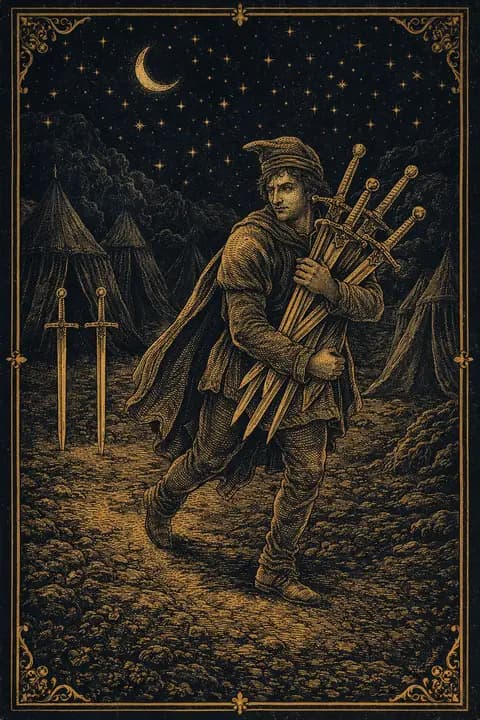
What does the Seven of Swords tarot card mean?
On tiptoe, a man leaves a row of tents with five swords in his arms. Two more stay stuck in the ground behind him. He looks back over his shoulder with a half smile. Soldiers can be seen in the camp, and none of them has noticed yet.
The scene is a short story about a calculated risk. He took what he could carry and left what he could not, and he is betting nobody looks up in time. In a reading the questions are who is the thief, who is the camp, and what exactly is being taken.
| Position | Keywords | In one line |
|---|---|---|
| Upright | Stealth, strategy, deception, secrecy, going it alone | Something is being done out of sight |
| Reversed | Confession, getting caught, a guilty conscience, coming clean | The secret comes out |
The tents, the two swords left behind and the yellow sky
The tents are a military camp, the people or the system being bypassed. The bright yellow sky is daylight, which makes the theft bolder and the risk of being seen higher. The two swords left in the ground carry a lesson of their own: he could not take everything, and what he left behind is evidence. Greed, or overreaching, is how clever plans come undone.
Sense something is not being said?
Pick five cards for your own question and get them read together with your birth chart, for a look at the situation from an angle you may have missed.
Check what is unsaidDeception, or just discretion?
The tradition draws a line between two uses. One is clear deception: lying by omission, taking credit, sneaking around or a partner hiding something. The other is quiet strategy: knowing that the loud approach will fail and choosing a more careful, indirect route.
A fair test is whether the plan would survive being said aloud to the people it affects. If it would embarrass you, it leans to the first reading. If it simply needs patience and good timing, it leans to the second.
- You: acting alone, avoiding a confrontation or keeping a plan quiet.
- Someone else: a person who is not fully candid with you.
- A situation: something is being done behind the scenes.
Seven of Swords in love: secrets at every stage
In relationships, this card is a flag for secrecy. It can describe a partner who is evasive, an affair, or something smaller like hidden spending or avoided conversations. It deserves careful reading: a card is not evidence, and drawing it is no reason to accuse anyone. A better first use is to ask what you may be hiding yourself, or what you have been avoiding saying. Often the thing hidden is a fear, not a betrayal.
| Situation | Upright | Reversed |
|---|---|---|
| Single | Someone who is not fully available, or not fully honest about it | The truth about a person comes out early, which saves time |
| In a relationship | Something unsaid, from hidden spending to a secret contact | A confession, or a discovery that forces a real talk |
| With an ex | Keeping in touch behind someone's back, or a quiet exit | Admitting why you really left, or why you still reach out |
Seven of Swords as feelings: more than they show
As someone's feelings, the Seven suggests there is more going on than they show. They may be more interested than they admit, more hesitant than they say, or unsure how to bring up a topic that complicates things. It is not proof of anything sinister. The full picture is missing, so ask a direct, friendly question and notice whether the answer is specific.
Reversed as feelings, guilt is in the picture. They may feel bad about something they did or did not say, and be close to telling you.
What to do with a Seven of Swords hunch
Many people draw this card because they already suspect something. Treat the card as a reason to look, not a reason to act. Write down what you have actually seen, separate it from what you have guessed, and ask about the seen things only, calmly and once. Checking a partner's phone or setting traps tends to make the card come true in a new way: now two people are acting in secret.
If the hunch is about yourself, the work is simpler and harder at once. Say the thing you have been keeping back to one person who can hear it, before circumstances say it for you.
Seven of Swords reversed: coming clean
Reversed, the plan comes apart. A sword drops, a secret is discovered, or the person decides to confess before it is exposed. The tradition sees conscience catching up. It is also a fine card for admitting a mistake, since the cost of honesty tends to be smaller and shorter than the cost of keeping the story going.
If you are the one with the secret, a confession offered freely lands very differently from one pulled out of you. The card does not decide whether a relationship survives the truth. It says the hiding phase is ending.
Seven of Swords at work and with money
Be careful with credit, contracts and sources. The card can describe a colleague who takes credit, a deal with fine print, or your own temptation to cut a corner. It can also describe a legitimate quiet job search or a plan you keep private until it is ready. With money it warns of scams, hidden fees and offers that look too clever by half, so read the terms and keep receipts. Reversed, the secret comes out: a hidden fee surfaces, a colleague's scheme is exposed or your own shortcut is found. Admitting a mistake at work before someone else finds it is usually the cheaper route.
The Seven of Swords as advice
Get the facts in writing and be straight about your own part. If you are tempted to skip the awkward step, ask what you would do if the whole camp were watching. If you need to act alone, fine, but act alone in a way you could explain later.
Seven of Swords astrology: the Moon in Aquarius
The Golden Dawn titled the card Lord of Unstable Effort and gave it the Moon in the third decan of Aquarius, roughly February 9 to 18; Crowley's Thoth deck calls it Futility. A changeable Moon in a detached, unconventional sign fits a plan that depends on staying out of reach. Seven is the number of testing and assessment in the minor cards, the point where each suit asks whether its gains will hold. Its major echo is the Chariot, card seven, which wins by control in the open where this card wins by evasion.
Is the Seven of Swords a yes or no?
Upright it is a no, or a yes that carries risk: information is incomplete and something is not being said. Reversed it moves to a maybe, because the truth is coming out, which can clear the way for a clearer answer.
Seven of Swords in past, present and future
Past: something was hidden, and its effects are still with you even if the secret is old. Present: the full story is not on the table yet, so hold big decisions until it is. Future: a plan will need discretion, or a secret will surface. Either way, be the person whose version of events holds up.
Seven of Swords with other cards
Paired cards tell you what kind of secret it is.
- With the Moon: deception, illusion or a fear that distorts the facts.
- With the Two of Cups: a secret relationship.
- With the Page of Swords: spying, gossip or information passed on.
- With the Five of Swords: winning by underhand tactics.
Sense something is not being said?
Pick five cards for your own question and get them read together with your birth chart, for a look at the situation from an angle you may have missed.
Check what is unsaidQuestions people ask
Read next
More in tarot