Tarot cards: what they mean and how to read them
Updated October 10, 2026 · How we write these pages
The short answer
Tarot cards are a deck of 78 picture cards used for reflection and divination. The 22 major arcana describe life's big themes and the 56 minor arcana, in four suits, describe daily events. To read them you shuffle, lay cards in a spread where each position asks a question, and read each card against that question.
Free tarot
Today's card
One card for everyone, seeded by today's date. It changes at your midnight.
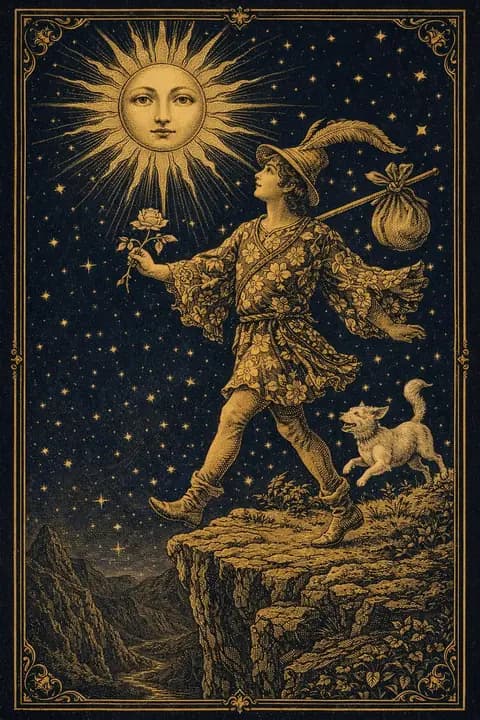
What are tarot cards?
A tarot deck is a set of 78 illustrated cards. Each one carries a name, a number and a scene, and over five centuries readers have built a shared vocabulary for what each scene stands for. When people talk about tarot today they almost always mean using those cards to think through a question: a relationship, a decision at work, or what deserves attention this week.
The deck has two parts. The major arcana, from the Latin for greater secrets, are 22 cards numbered 0 to 21, from The Fool to The World. They show archetypes such as The Lovers, Death and The Star, and when one turns up a reader treats it as a large theme rather than a passing event. The minor arcana are the other 56 cards, in four suits of fourteen: ace to ten, then four court cards called Page, Knight, Queen and King. They read like the scenes of ordinary life, the arguments, the paychecks, the parties and the long nights.
| Part of the deck | Cards | What it covers |
|---|---|---|
| Major arcana | 22, numbered 0 to 21 | Turning points, life lessons, the big story |
| Wands | 14, element of fire | Drive, ambition, creativity, new projects |
| Cups | 14, element of water | Love, feelings, friendship, intuition |
| Swords | 14, element of air | Thought, conflict, truth, decisions |
| Pentacles | 14, element of earth | Money, work, the body, home and security |
Where tarot comes from
Tarot began as a card game, not a fortune-telling tool. Decks called carte da trionfi, later tarocchi, were painted for noble families in northern Italy in the fifteenth century, and the hand-painted Visconti-Sforza cards made in Milan are the best known survivors. The extra picture cards were trumps in a trick-taking game that is still played in France and parts of central Europe.
The link with the occult came three centuries later. In 1781 the French scholar Antoine Court de Gebelin claimed the cards held the lost wisdom of ancient Egypt. There is no evidence for that, but the idea caught on, and within a decade a Parisian occultist who went by Etteilla had published one of the first decks made for divination. In the late nineteenth century the Hermetic Order of the Golden Dawn in London tied each card to astrology, the Hebrew alphabet and the Kabbalah, and those links still shape how most English-speaking readers work.
Ask the cards your own question
Pick five cards for the question on your mind and get them read together, with your birth chart. The reading is written by AI the moment you join.
Get my five-card readingThe Rider-Waite tarot deck, and why most guides use it
Two Golden Dawn members made the deck most people now picture when they hear the word tarot. Arthur Edward Waite wrote the meanings and the artist Pamela Colman Smith painted all 78 scenes, published by William Rider and Son of London in December 1909. Waite's guide, The Pictorial Key to the Tarot, followed in 1910. It is sold as the Rider-Waite deck, and many readers now call it Rider-Waite-Smith to credit the woman who drew it.
Its breakthrough was the minor arcana. Earlier decks showed the Five of Cups as five cups in a pattern; Smith painted a cloaked figure mourning three spilled cups with two still standing behind him. Because every card has a scene, a beginner can read the picture before knowing the meaning, and nearly every modern deck, from indie art decks to the ones in bookstores, keeps her compositions. Every card page on this site describes the Rider-Waite-Smith image.
The other two traditions are worth knowing by name. Marseille decks, printed in France from the 1600s, show patterned pip cards and are read through number and suit. The Thoth deck, designed by Aleister Crowley and painted by Frieda Harris, was published in 1969 and renames several cards, such as Lust for Strength and Art for Temperance.
| Tradition | Pip cards | Good for |
|---|---|---|
| Rider-Waite-Smith (1909) | A full scene on every card | Learning, and most guides online |
| Marseille (1600s on) | Patterns of suit symbols | Number-based reading, history |
| Thoth (1969) | Abstract art, one-word titles | Astrology and Kabbalah-heavy study |
What do tarot cards mean?
No card has one fixed meaning, but none of them means just anything either. A card's traditional meaning comes from a few layers read together: the picture, the card's number, its suit and element, and the meanings handed down by writers like Waite. The Three of Cups shows three women raising their cups at a harvest, so it speaks of celebration and friendship. The Ten of Swords shows a man face down with ten blades in his back, so it speaks of a painful ending.
Numbers carry their own logic through the minor arcana. Aces are pure potential, twos are choices and partnerships, fives are friction, and tens are a cycle finished, for better or worse. Court cards describe either people in your life or the way you are acting: Pages learn, Knights chase, Queens hold and nurture, Kings direct. Then the question decides the emphasis. The Empress in a love reading leans toward affection; in a money reading the same card leans toward growth and comfort. Our list of all 78 tarot card meanings gives each card upright and reversed, with its astrology and its yes or no answer.
- Wands are fire: what you want and what you are willing to start.
- Cups are water: what you feel and who you feel it for.
- Swords are air: what you think, say and argue about.
- Pentacles are earth: what you build, earn and keep.
How to read tarot cards, step by step
Reading tarot is a skill you learn by doing, and it starts simpler than most people expect. You do not need to memorize 78 meanings before your first reading. You need a clear question, a spread, and the patience to look at what is actually on the card.
- Ask an open question. "What do I need to understand about this job offer?" gives the cards more to say than "Will I get rich?"
- Shuffle until it feels done, then cut the deck or draw from the top.
- Lay the cards in a spread, and decide before you turn them what each position stands for.
- Look at each picture before you look up its meaning. Note who is in the scene, what they are doing and what catches your eye.
- Read the traditional meaning, then ask how it fits the position and your question.
- Read the cards together. Several cards from one suit, or a run of major arcana, says something on its own.
- Sum the reading up in one sentence, and write it down with the date so you can look back.
How to shuffle tarot cards
There is no rule about how a tarot deck must be shuffled, only about shuffling enough that you cannot steer the result. Tarot cards are larger and thicker than playing cards, so the casino riffle, where you bend two halves and let them fall together, is hard on them and creases the corners. Most readers use one of four gentler methods and stop when the deck feels mixed, usually after half a minute.
If you read reversals, turn half the deck end to end once before you shuffle and again partway through, or the cards stay mostly upright. Some readers cut the deck into three piles with the left hand and restack them, an old custom with no fixed meaning, and some knock on the deck or hold it while they repeat the question. Choose whatever helps you focus, and use the same method each time so the ritual becomes a cue to pay attention.
- Overhand: hold the deck in one hand and drop small packets into the other, over and over.
- Washing: spread the cards face down on a table and swirl them with both hands, which also mixes reversals.
- Piles: deal the deck into several piles in turn, then stack the piles in any order.
- Bridge: a soft riffle with the cards barely bent, if your deck is sturdy enough.
Which tarot spread to start with
A spread is a layout where each position asks its own question. The cards are the vocabulary; the spread is the grammar. Start small, because a ten-card layout is hard to read well until each card feels familiar. A single card a day is the best practice there is, and a three-card spread, such as past, present and future, is the classic next step. Our guide to tarot spreads lays each one out, position by position, with a free draw for the two classic three-card spreads and the ten-card Celtic Cross that Waite printed in 1910.
Reversed cards: read them or skip them?
A card that comes out upside down is called reversed. Some readers ignore reversals and turn every card upright. Others read a reversed card as the opposite of its upright meaning, and many read it more subtly: the card's energy is blocked, delayed, turned inward or only partly present. Reversed Strength, for example, is less often cowardice than self-doubt, courage you have but are not using yet.
Neither approach is wrong, as long as you choose before the reading starts. If you are new, read upright only for your first weeks, then add reversals once the core meanings feel familiar. Our card pages give both, and our free draws turn cards either way at even odds, the way a well-washed paper deck does.
How to choose a tarot deck
If you are learning, pick a deck with fully illustrated minor arcana in the Rider-Waite-Smith tradition. A scene for every card means you can read the picture instead of memorizing a list. Beyond that, choose art you want to look at every day, and check that the card stock shuffles well in your hands, since a deck that sticks or slides is one you will stop using.
The old idea that your first deck must be a gift is folklore, and buying your own is fine. So is reading with an app while you learn. What matters is that the images speak to you, because reading the picture is half of reading tarot.
Online and AI tarot readings
An online tarot reading uses the same deck and spreads, with the shuffle done by a computer. A fair digital shuffle picks every card with equal chance, which is what a well-shuffled paper deck does too. Every draw on our pages uses the full 78-card deck and turns each card upright or reversed at even odds.
Soulether's full readings are written by AI from the cards you draw, the question you ask and your birth chart, following the traditional meanings on these pages. They are not written by a human psychic, and no reading, paper or digital, can promise what will happen. Treat it as a structured way to think, not a forecast.
What tarot can and cannot do
Tarot is good at slowing you down. A card you did not choose puts a new picture in front of a familiar worry, and that often surfaces what you already half knew. Many people use it as a journaling prompt, a creative exercise or a ritual of reflection. It cannot replace advice from a doctor, a lawyer, a financial adviser or a therapist, and it is not evidence about another person's private thoughts. Read with that in mind and tarot becomes what it does best: a mirror with 78 different angles.
Ask the cards your own question
Pick five cards for the question on your mind and get them read together, with your birth chart. The reading is written by AI the moment you join.
Get my five-card readingQuestions people ask
How many cards are in a tarot deck?
A standard tarot deck has 78 cards: 22 major arcana numbered 0 to 21, and 56 minor arcana split into four suits of 14. Each suit runs from ace to ten, followed by the Page, Knight, Queen and King.
Can I read tarot cards for myself?
Yes. Most readers practice on themselves first, and a daily one-card draw is the usual way to start. The hard part is staying honest when a card is not the one you hoped for, so write each reading down and look back later.
Do tarot cards predict the future?
There is no scientific evidence that tarot predicts events. Readers in the modern tradition treat a reading as a picture of the forces around a question, and of where things may head if nothing changes, which you are free to change.
Is the Rider-Waite deck good for beginners?
It is the most common first deck for a reason: every one of the 78 cards has a scene, and almost every book and website describes its images. Any deck that copies its layout, sometimes called a Rider-Waite clone, works the same way.
How long does it take to learn tarot?
You can give a simple three-card reading after a few days with a guide. Knowing all 78 cards well enough to read without one usually takes a few months of regular practice, and readers keep finding new layers for years.
Every tarot page
Read next