Death tarot card meaning: endings, transformation and release
Updated October 10, 2026 · How we write these pages
The short answer
The Death tarot card almost never means a physical death. It means an ending that makes room for something new: a chapter closing, a transformation. Upright, card 13 says let the old thing go. Reversed, it points to clinging, stagnation and fear of change. As a yes or no answer, Death is a no to keeping things as they are.
Draw a card
Pull one card from the full deck
A fair shuffle of all 78 cards, upright or reversed. Tap the deck to turn your card.
Tap to turn
Does the Death card mean someone will die?
No. This is the question every reader is asked about card 13, and the answer in modern tarot is consistent: the Death card is symbolic. It describes the end of a phase, a relationship, a job, a belief or a version of yourself. Readers who have worked with the deck for decades will tell you it is one of the most common cards in ordinary readings, and the people who draw it go on living.
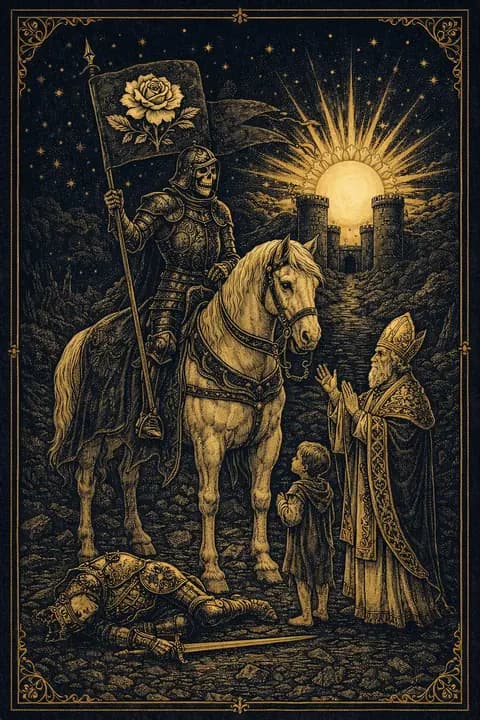
The card looks frightening on purpose. Endings are frightening, even good ones. But the image itself carries the reassurance: a sun rises between two towers in the background, and a river flows on toward it. The scene is a passage, not a stop.
What does the Death tarot card mean upright?
Upright, Death is the clean ending. Something has run its course, and the card says to let it finish rather than keep it on life support. That might be a relationship that is over in everything but name, a job you have outgrown, a habit, a home or an identity. Death is not the same as disaster; it is closer to a season changing. The leaves fall so the tree can live through winter.
The card also promises transformation. What comes after a Death card is usually better suited to who you are now, though it rarely arrives the same week. The space between an ending and a beginning is part of the card, and it asks you to tolerate that emptiness rather than rush to fill it.
| Area | Upright | Reversed |
|---|---|---|
| Keywords | Endings, transformation, transition, release | Resisting change, stagnation, fear of endings, holding on |
| Love | A relationship ending or transforming completely | Clinging to something already over |
| Work | Leaving a job or field; a role restructured | Staying in a dead-end job out of fear |
| Yes or no | No | Maybe |
What is ending, and what comes next?
Five cards for the change you are living through: what is ending, what it makes room for and what to do now. Read with your birth chart. Written by AI the moment you join.
Read my changeSymbols on the Death card
Notice the child looking up at Death without fear. Readers take that as the card's lesson: the less we cling, the less it frightens us.
- The skeleton in black armor on a white horse: the force of change, which no armor stops.
- The black banner with a white rose: purity and new life inside the ending.
- The fallen king: power and status cannot argue with change.
- The praying bishop, the child and the woman: every age and rank meets endings, each in their own way.
- The sun rising between two towers: rebirth on the horizon, the same towers that appear on The Moon.
- The river and the boat: passage from one state to another, as in the myth of the ferryman.
Death reversed
Reversed, Death is an ending that is being resisted. You may know something is over and still be holding on: staying in the relationship, keeping the job, repeating the habit, because the unknown feels worse than the familiar. The result is stagnation, a life that has stopped moving because one part of it refuses to die.
Sometimes the reversed card means the change is happening slowly, in stages, rather than in one clean cut. Either way it asks what you are protecting by not letting go, and whether it is worth the price.
Death tarot love meaning
In love the Death card is frightening to draw and often more nuanced than it looks. It means something ends, and that something is not always the relationship itself.
| Stage | Upright | Reversed |
|---|---|---|
| Single | Closing the door on a past love; a whole new chapter in how you date | Still carrying an old relationship into new ones |
| Dating | A connection that will not survive this stage, or one that transforms into something serious | Hanging on to something that has already faded |
| In a relationship | An old version of the relationship ends: a move, a marriage, children, or a breakup | Avoiding a necessary change, or a slow fade nobody names |
| With an ex | A real ending; time to stop waiting | Holding on to hope that is keeping you stuck |
Death as feelings
As feelings, Death means the person's feelings are changing profoundly. They may be ready to end something, or they may be transformed by their feelings for you, seeing life differently because of the relationship. It is intense rather than light. Reversed, they may be clinging to feelings that have faded, or afraid of how much you are changing them.
Death in career and money
At work Death often means a job ending, a company restructuring, a career change or leaving a field entirely. It can be frightening, and it is often the start of better-fitting work. It favors letting go of what is clearly finished. With money it can mark the end of one income stream or a financial era, and it is a good moment to close old accounts and debts cleanly. Reversed, you may be staying in a dead-end role because change feels too risky.
Death as advice
As advice, Death says finish it. Name one thing in your life that is over and give it a proper ending: the conversation, the letter, the resignation, the clear-out of the closet. Grieve it if you need to. Then leave the space empty for a while, and see what grows there.
Is Death a yes or no card?
Death is a no, particularly a no to keeping things as they are or getting something back. It can be a yes to change, if that is what you asked about. Reversed it lifts to maybe: the ending is not complete, and the outcome depends on whether you let it finish.
Death in past, present and future
In the future position, readers stress the second half of the card: transformation, not loss alone.
- Past: an ending, perhaps a painful one, cleared the ground for what is happening now.
- Present: something is finishing. Let it.
- Future: a significant ending and transformation is coming, and it will make room for something new.
Death's astrology, element and number
The Golden Dawn gave Death the sign of Scorpio and the Hebrew letter Nun, a fish. Scorpio is fixed water, ruled by Mars and, for modern astrologers, Pluto, the planet of death and rebirth. Scorpio's whole territory is the card's: intensity, endings, transformation, and the phoenix that rises from the ashes.
Its number, 13, has an unlucky reputation that has nothing to do with tarot. In the deck it reduces to 4, The Emperor, which readers take as a reminder that endings clear space for new structure. Card 13 falls late in the second row of the Fool's journey, the inner world, where an old self has to die before Temperance can rebuild.
What to do when Death keeps coming up
If the Death card appears in reading after reading, readers take it as a sign that something has ended and you have not accepted it yet. Ask the plain question: what am I still carrying that is already over? Write the answer down. Often the card stops repeating once you name it, because the reading has nothing left to tell you.
Death with other cards
Death versus The Tower: Death is a natural ending, like a season; The Tower is a sudden collapse, like lightning.
- Death and The Tower: a sudden, total change; the old structure falls and does not come back.
- Death and the Ten of Swords: a painful ending that is final.
- Death and The Star: an ending followed by real healing and hope.
- Death and the Eight of Cups: you are the one walking away.
- Death and the Ace of Cups: an emotional rebirth, new love after an ending.
What is ending, and what comes next?
Five cards for the change you are living through: what is ending, what it makes room for and what to do now. Read with your birth chart. Written by AI the moment you join.
Read my changeQuestions people ask
Is the Death card bad?
Not usually. It is uncomfortable, because it means something is ending, but it is a card of transformation and renewal. Many readers see it as positive, since it clears space for what comes next.
What does Death mean in a love reading?
An ending or a complete transformation. It can mean a breakup, or it can mean the end of one stage of a relationship, such as dating, as it becomes something deeper. Reversed, it points to clinging to something over.
Can the Death card mean pregnancy or a new beginning?
It is about endings first, but every ending in the card leads to a beginning, symbolized by the rising sun. Readers do not use it to predict pregnancy; with the Ace of Cups or The Empress nearby it suggests renewal.
What does Death reversed mean?
It means resisting a necessary ending, stagnation or fear of change. It can also mean a slow, partial transformation. It asks what you are holding on to and what it costs you.
Read next
More in tarot