
Five of Swords tarot card meaning: winning the fight, losing something else
Updated October 17, 2026 · How we write these pages
The short answer
The Five of Swords means a conflict that was won at a cost. Someone gets their way while others walk off hurt, so the victory feels hollow. Upright, it warns of pride, arguments and betrayal. Reversed, it points to reconciliation, regret, or finally dropping a fight.
Draw a card
Pull one card from the full deck
A fair shuffle of all 78 cards, upright or reversed. Tap the deck to turn your card.
Tap to turn
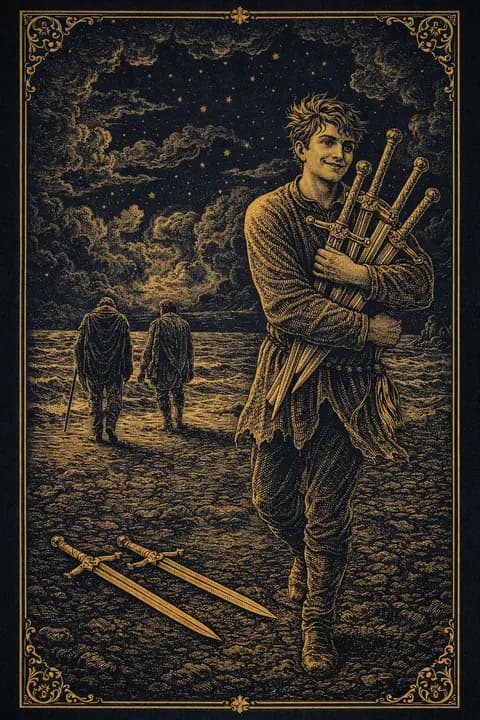
What does the Five of Swords tarot card mean?
The card is popularly summed up as a victory not worth having. It asks you to look at what your win cost: a friendship, trust, your own sense of fairness. Five is the number of disruption in the minor cards, the point where the stability of the four breaks, and in the suit of the mind that break takes the form of an argument.
| Position | Keywords | In one line |
|---|---|---|
| Upright | Conflict, a hollow win, pride, scorekeeping, underhand tactics | You won, and nobody is celebrating |
| Reversed | Reconciliation, regret, an apology, walking away from a fight | The fight loosens, or the shame of it lingers |
Who is the winner in the picture?
In the foreground a smirking figure gathers three swords from the ground, glancing back over his shoulder. Two others walk away toward the sea with their heads bowed, their swords left behind. Interpreters argue about who you are in this scene. The common view makes the man in front the winner, someone who wins through tactics and then finds nobody celebrating. A second puts you among the departing figures, leaving a fight that cannot be won on fair terms. A third says the card holds all three, because inside most quarrels a person is partly each of them.
Ask yourself which figure you feel closest to today. The answer changes the advice.
- If you feel like the winner: ask what you gave up and whether you can repair it.
- If you feel like the loser: decide whether the fight deserves more of you.
- If you feel like the one walking away: leaving can be a strength, not a defeat.
Find what the argument is really about
Pick five cards for your own conflict and get them read together with your birth chart, to see what sits under it and what could ease it.
Read my conflictThe torn sky and the swords left behind
Three details do the quiet work. The clouds are ragged and streaming, the visual sign of a quarrel that has already broken the weather. Two swords lie on the ground where the others dropped them, which means the argument ended when the losers disarmed, not when anyone was convinced. And the two figures walk toward the water with their backs to the winner, so the card is as much about what happens after the fight as during it.
That last point is the practical one. A conflict like this does not close when someone concedes. It moves underground, into cooler replies and longer silences, and it comes back as resentment at the next small disagreement.
Five of Swords in love: new, long-term, single or after a breakup
In love, the card shows a quarrel where the aim has become winning, not understanding. It can describe a couple who keep score, a partner who must always be right, or a cutting remark that turned a small problem into a big one. The useful question is what you are really fighting about. Often it is not the dishes or the text message but something underneath, like respect or feeling heard. What that looks like depends on where the relationship stands.
| Stage | Upright | Reversed |
|---|---|---|
| New relationship | Early power games: who texts first, who apologizes, who has the upper hand | The games stop and someone is honest about wanting this |
| Long-term | Scorekeeping and old grievances brought into every argument | A real apology, and a fight that finally gets resolved |
| Single and dating | Meeting people who compete instead of connect, or a rival for someone's attention | Walking away from a dynamic you have seen before |
| After a breakup | Arguing about who was right long after it ended | Making peace with the ending, sometimes with each other |
Five of Swords as feelings: wounded pride
If you ask what someone feels about you, the Five often describes wounded pride. They may care and still be unable to concede, or they may feel they lost something in your last disagreement and are not over it. Competitiveness can pass for indifference. The practical reading is not to reach for romance but to lower the temperature and let them keep their dignity, so the underlying feeling has room to show itself.
Reversed as feelings, the pride is softening. They regret how the argument went and may be looking for a way back that does not require them to lose face. A small, friendly opening from you makes that easier.
Five of Swords reversed: peace talks and regret
Reversed, the conflict loosens. People apologize, terms are renegotiated, or someone finally says they were wrong. It can also mark a long grudge winding down because you no longer have the energy to keep it alive. The reversal has a heavier side as well: regret about a past argument, or the lingering shame of a thing said in anger. The remedy most traditions offer is the same: a sincere, brief apology without a defense attached.
In love this is one of the better reversals in the suit. Be careful with the opposite case: a partner who apologizes quickly to end an argument without changing anything has not repaired anything. Look for changed behavior over weeks, not a nice sentence tonight.
After the fight: should you reach out or walk away?
This is the question most people bring to the card, often the morning after an argument with a partner or an ex. The tradition gives two honest answers. If the fight was about winning and you still value the person, reach out first, keep it short, and do not relitigate who started it. A message such as I am sorry for how I spoke last night, can we talk this weekend does more than a long defense.
If the fight is one in a long line, and every reconciliation ends in the same argument, the departing figures in the card are the ones to copy. Walking away from a contest you cannot win fairly is not losing. It is refusing to keep playing.
Five of Swords at work and with money
At work, expect office politics, credit-taking or a negotiation where one side squeezes the other. The card does not forbid competing. It asks whether the way you are competing leaves you with allies afterward. A deal both parties can live with tends to outlast one that left someone bitter.
With money, it can describe a dispute over a debt, a split bill or an inheritance, where being right costs more than the sum involved. Count what else changes hands: goodwill, trust and time. Reversed, the dispute is ending through a settlement, an apology or the moment you walk away from a fight over money that was never worth winning. It can also warn of an old grudge that resurfaces at the next review.
The Five of Swords as advice
Win cleanly or not at all. Before you reply to the message that has you fuming, ask what you want the situation to look like in a month. That answer is often not a victory. It is a working relationship, a calm house or simply your own peace, and the route there rarely runs through the last word.
Five of Swords astrology: Venus in Aquarius
The Golden Dawn titled it Lord of Defeat and gave it Venus in the first decan of Aquarius, roughly January 20 to 29. The pairing is an odd one: Venus wants harmony and closeness, Aquarius is a detached, principled sign, and the tension shows up as a quarrel over ideas that damages a relationship. Being right about the principle and losing the person is the whole card in one sentence. The element is air, and the major arcana echo of five is the Hierophant, the card of rules and who gets to set them.
Is the Five of Swords a yes or no?
Upright it is a no. A yes may come, but traditionally with strings attached or at the expense of something valuable. Reversed it softens to a maybe, which suggests peace and resolution are still being negotiated.
Five of Swords in past, present and future
Past: an old argument, won or lost, still colors how you deal with this person. Present: a conflict is live, and how you fight it matters more than whether you win. Future: tension is coming, often over a point of principle, so decide now which hill is worth it and which is not.
Five of Swords with other cards
The neighbors show what the fight is about and where it goes.
- With the Two of Cups: a fight inside a couple that both want to survive.
- With the Seven of Swords: deception or cheating behind the conflict.
- With the Five of Wands: open competition or a rivalry.
- With Justice: a dispute heading to a formal or legal settlement.
- With the Three of Swords: words that cut deeper than intended.
Find what the argument is really about
Pick five cards for your own conflict and get them read together with your birth chart, to see what sits under it and what could ease it.
Read my conflictQuestions people ask
Read next
More in tarot