
Three of Swords tarot card meaning: heartbreak, named honestly
By Nick Krüger · Updated October 24, 2026 · How we write these pages
The short answer
The Three of Swords means heartbreak: grief, a painful truth or a loss that hurts because it matters. Upright, it names the pain without softening it. Reversed, it points to slow recovery, forgiveness and release, or to hurt held on to for too long.
Draw a card
Pull one card from the full deck
A fair shuffle of all 78 cards, upright or reversed. Tap the deck to turn your card.
Tap to turn
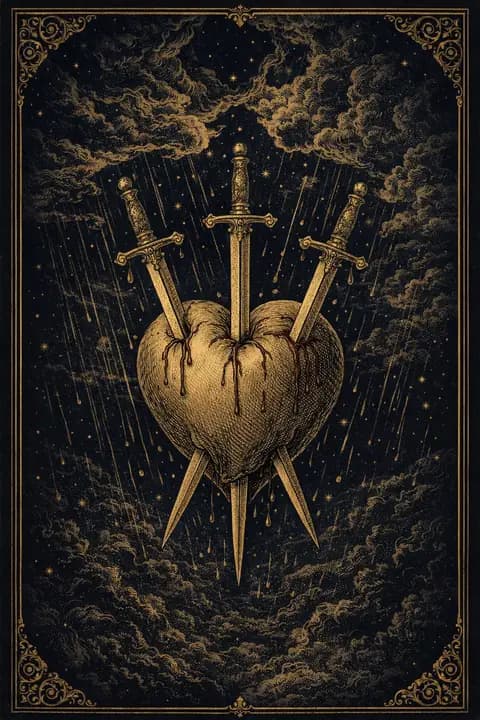
What does the Three of Swords tarot card mean?
Because these are swords, the card is less about the feeling than about the truth that caused it: something has been seen clearly, and seeing it hurts. A friend's real opinion, an honest diagnosis of a relationship, a fact you had been dodging. That is why it can arrive in readings that are not about romance at all, such as the moment a team learns a project is ending, or a family finally speaks about a long silence.
| Position | Keywords | In one line |
|---|---|---|
| Upright | Heartbreak, grief, painful truth, rejection, sorrow | It hurts, and the hurt is real |
| Reversed | Recovery, forgiveness, release, or old pain replayed | The swords start to come out, slowly |
Grief or betrayal: which Three of Swords is it?
The same picture covers two kinds of hurt, and the surrounding cards usually tell them apart. Grief is pain with no villain: a death, an illness, a person who moved away. Betrayal is pain with a name attached: a lie found out, a promise broken, trust spent.
The distinction changes the advice. Grief asks for time, company and ritual. Betrayal asks for a boundary and a decision about what happens next. If you cannot tell which one you are carrying, the honest answer is often both at once.
| Kind of hurt | What it feels like | What helps |
|---|---|---|
| Grief | Heavy, tender, no one to blame | Time, company, small rituals |
| Betrayal | Sharp, angry, replaying events | A boundary and a plan |
Make sense of a hard chapter
Pick five cards for your own situation and get them read together with your birth chart, for a calm look at what comes after the hurt.
Read what comes after thisThe pierced heart, the rain and the gray sky
It is the most direct image in the deck. A red heart floats against a gray sky with rain falling, and three swords pass straight through it. There is no figure to blame and no escape route drawn in. It shows pain as a fact, the way rain is a fact.
The heart is intact in the drawing, only pierced, which suggests the grief can be survived. Rain is the old picture of tears, and rain also ends. Pamela Colman Smith drew a storm, not a ruin.
Upright, the card is the moment of impact: the message read, the conversation finished, the result confirmed. It does not say what you should have done differently. It says that what happened has happened, and that the hurt is the proof it mattered to you.
Three of Swords in love by relationship stage
In love readings this is the classic heartbreak card, and it is usually about something that has already happened or is clearly arriving: a breakup, the discovery of dishonesty, a love that is not returned. It does not predict a split from nowhere. It names what the heart already suspects. A love triangle is a popular reading, since there are literally three swords, but treat it as one possibility, never as a verdict about anyone's character.
| Situation | Upright | Reversed |
|---|---|---|
| Single | Rejection, or a crush that was not returned | Ready to stop replaying an old hurt |
| In a relationship | A painful truth, a betrayal or an honest fight that hurts | Forgiveness and repair after a rupture |
| With an ex | The grief of the ending is still fresh | Thinking of them without the stab, and talking calmly is possible |
Three of Swords as feelings
When the question is what someone else feels, the Three can mean they are hurting, possibly because of you or because of something unspoken between you, or that they feel sorrow about a decision they cannot take back. It is not a hostile card. A person in this state needs room and a sincere message more than an argument.
Reversed as feelings, the pain is easing. They may be ready to talk about what happened, or they have quietly forgiven more than they have said.
Three of Swords reversed: recovery, or reopening the wound
Reversed, the swords begin to come out. The tradition connects this with forgiveness, with the first day you think of someone without grief, or with finally telling someone what happened. It does not erase the scar. It suggests the worst of it has passed.
People often ask whether the reversed Three means an ex returns. The tradition does not promise that. It describes pain loosening, so the more useful question is whether you could talk about the past calmly. If you caused the hurt, expect to owe a plain apology and patience. If you were hurt, decide what repair would actually look like before you answer any message.
There is a less comfortable version. Reversed can describe pain you keep alive by replaying it, or a hurt you refuse to talk about because speaking would make it real. If this is you, a trusted person or a counselor will help more than a card will.
Three of Swords at work, with money and between friends
At work the card fits being passed over, losing a role or learning that a trusted colleague spoke against you. In money questions it can describe a loss that stings because of what it meant, such as a deal that fell through or a loan to a friend that will not come back. Among friends, it is the hurt of drifting apart or of being left out of something that mattered. Reversed, it is the slow recovery after a rejection or a lost deal, or a grudge against a former employer that keeps costing you references and sleep.
In every setting the counsel is the same: do not rush to fix the feeling. Say what happened in plain words, to yourself first and then to someone who will listen.
The Three of Swords as advice
Let it hurt for as long as it honestly hurts, and no longer. Name the loss, tell one person, and keep a small daily routine running underneath the grief: meals, sleep, a walk. If the pain feels unmanageable, a professional is the right place to turn.
Three of Swords in past, present and future
Past: an old heartbreak still shapes how carefully you love. Present: you are in the sharpest part of a hurt, and naming it is the first step out. Future: a hard truth is coming to light. That sounds frightening, but the card usually points to something you already half know, and hearing it ends the suspense.
Three of Swords astrology, element and number
The Golden Dawn titled the card Lord of Sorrow and gave it Saturn in the second decan of Libra, roughly October 3 to 12. Saturn stands for limits and hard lessons, Libra for relationships and fairness, so the pairing describes a lesson about love or justice that arrives as a loss first. Three is normally the number of growth and of the first result; in the suit of air the first result of a divided mind is a wound.
Compare the Three of Cups, where three women raise their glasses in a garden and the same number means company and celebration. One is the party, the other is the phone call the next morning.
Is the Three of Swords a yes or no?
Upright it is a no. The card is a picture of hurt and rarely supports a hopeful answer about a specific outcome. Reversed it eases to a maybe: the hurt is lifting, though it is not yet gone.
Three of Swords with other cards
Look at the neighbors to see where the heartbreak leads.
- With the Star: healing after heartbreak, slowly and for real.
- With the Three of Cups: hurt inside a friend group, or a third person.
- With the Five of Cups: dwelling on what was lost.
- With the Tower: a sudden shock that breaks the heart.
- With the Ten of Swords: a betrayal that ends things for good.
Make sense of a hard chapter
Pick five cards for your own situation and get them read together with your birth chart, for a calm look at what comes after the hurt.
Read what comes after thisQuestions people ask
Read next
More in tarot