
Seven of Wands tarot card meaning: defending the high ground
Updated October 17, 2026 · How we write these pages
The short answer
The Seven of Wands is the card of defending what you have earned. A figure on higher ground fends off six staves rising from below. Upright, it means perseverance, courage and holding your position under challenge. Reversed, it means overwhelm, exhaustion or abandoning a position you could have held.
Draw a card
Pull one card from the full deck
A fair shuffle of all 78 cards, upright or reversed. Tap the deck to turn your card.
Tap to turn
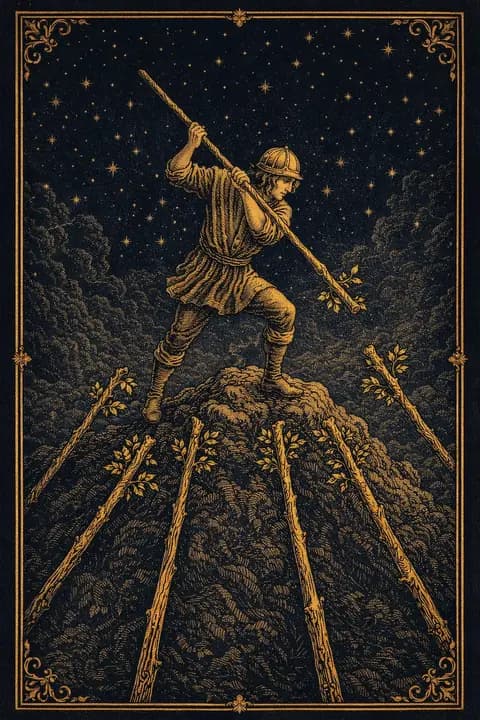
Seven of Wands (7 of Wands) at a glance
Suit and element: Wands, fire. Astrology: Mars in Leo, the third decan of the sign in the Golden Dawn scheme, a fighting planet in the sign of pride.
| Quick facts | Upright | Reversed |
|---|---|---|
| Yes or no | Maybe | No |
| Keywords | perseverance, standing your ground, challenge, defense | overwhelm, giving up, exhaustion, feeling attacked |
| In love | A bond tested from outside, held firm | Defensiveness, walls up, nowhere to rest |
| At work | A role or idea others want, defended | Burnout from constant defending |
Seven of Wands upright meaning: outnumbered, still ahead
On the classic card, a man stands at the top of a hill holding one staff at an angle while six others rise at him from below the edge of the frame. He is outnumbered, and yet he holds the better position. Soulether's art draws the same stand with the staff raised overhead and the other staves planted in the slope beneath him.
That mix of pressure and advantage is the whole card. You are being challenged, probably by people or circumstances you did not choose, but you have something worth defending and some leverage. The Seven is not a charge. The figure stays put and uses the height, which is a strategy: protect what you have instead of starting new fights, and keep your footing.
Under pressure and unsure what to hold?
Five cards and your birth chart, read by AI, on what is worth defending and what you can set down.
Draw my cardsSymbols on the Seven of Wands: the shoes, the hill and six staves
In the classic drawing the figure wears one boot and one shoe. That is read as being caught off guard and taking a stand anyway, which suits the idea of defending a position in imperfect conditions. It is a detail of that particular drawing, not a rule about every deck. Soulether's art leaves the footwear out and keeps the stance.
| Symbol | What it says |
|---|---|
| One boot, one shoe | Caught unprepared, and standing anyway |
| The higher ground | Your advantage: position, skill or work already done |
| Six staves from below | Challengers you cannot fully see, since only their staves show |
| A staff held across the body | Defense, not attack |
Seven of Wands upright: how to stand firm
Upright, the card calls for courage without aggression. Typical situations include a role at work that others want, an opinion you must defend in a meeting, a boundary people keep testing or a project critics keep trying to derail. Your position is stronger than it feels.
- Write down exactly what you are defending, and why it matters to you
- Decide which challenges deserve an answer and which can be ignored
- Rest between rounds: the card rewards stamina, not constant alertness
Seven of Wands reversed: overwhelmed or retreating
Reversed, the figure slips. The familiar readings are overwhelm, giving up, exhaustion and feeling attacked. Sometimes it describes real harassment or relentless demands. Sometimes it is a mood, a sense of being under siege when most people around you are not hostile at all.
Two questions help. Is the thing you are defending still worth it? And do you need allies rather than more willpower? A reversed Seven can be a signal to ask for backup or to let go of a battle that was never yours.
How does the Seven of Wands read in love?
In love, the card suggests a relationship tested from outside: opinionated family, distance, a rival or old patterns. It can describe two people choosing each other against resistance and growing sturdier for it. It can also point to defensiveness inside the relationship, where one partner treats every question as an attack.
For singles, it may show a person who has been hurt before and keeps the walls up. A boundary is healthy. A fortress is lonely.
| Stage | Upright | Reversed |
|---|---|---|
| Single | A boundary kept after a hurt, which is not yet a fortress | Giving up on dating after one knock too many |
| In a relationship | Defending the bond against family, distance or a rival | Every question taken as an attack |
| With an ex | Holding your no when they push | Worn down, and letting them back in out of tiredness |
Seven of Wands as feelings: guarded, protective, not yet open
As someone's feelings, the Seven of Wands is a person who is holding a line. They may be protective of you, or protective of themselves against you, and the card does not say which. What reads as coldness is often a defense they built after a bad experience. They see you as someone to be careful with, and sometimes as someone who might challenge the position they have taken.
They care about respect more than comfort. If you push them to soften a stance, they will tighten it. If you acknowledge it first, the hill gets lower.
Reversed, the same person is wearing down. They may be close to dropping a defense they no longer have the strength for, or retreating from a relationship in which they no longer feel safe. Do not press for an answer on a day when they are tired.
Seven of Wands in a career reading
At work it is a competition card: you hold a role or an idea that others would like to take. Know your value, speak plainly about your results and avoid being drawn into every skirmish. Reversed, it can mean burnout from constant defending, and a reason to ask whether this is the right hill.
On money, it favors protecting savings, a client or a price you have set, rather than discounting under pressure.
Is the Seven of Wands yes or no?
Upright, it is a maybe: you can succeed, but not without resistance, so expect a contest and decide whether you can bear it. Reversed, the answer slides to no, or at least no unless you get support or lower what you are trying to protect.
Seven of Wands as advice and as an outcome
As advice, the Seven says hold, and hold with a plan: know what you will not give up and what you can trade. As an outcome, it ends with you still standing, which is a result by itself.
| Position | The Seven of Wands says |
|---|---|
| Past | You defended something and learned how much you could take |
| Present | You are under pressure from a position of some strength |
| Future | A challenge is coming, and the ground you have is worth keeping |
Seven of Wands astrology: Mars in Leo and the number seven
The Golden Dawn called this card the Lord of Valour and gave it the last ten degrees of Leo, under Mars. Mars fights and Leo will not be shamed, so the decan is courage with pride on the line. The figure is not defending land so much as his standing, which is why the card so often turns up when someone's reputation or role is being challenged.
Seven tests what the six won. Each suit's seven puts its gains under pressure: illusions in the Seven of Cups, stealth in the Seven of Swords, a slow harvest in the Seven of Pentacles. The fire seven is the plainest of them, one person on a hill being asked whether they meant it.
Seven of Wands combinations
The card beside the Seven tells you what is under siege.
| With | Reads as |
|---|---|
| Strength | Calm endurance that outlasts the challengers |
| The Emperor | Defending authority or a structure you built |
| The Moon | Pressure that feels bigger in the dark than it is |
| Six of Wands | The win you now have to protect |
Under pressure and unsure what to hold?
Five cards and your birth chart, read by AI, on what is worth defending and what you can set down.
Draw my cardsQuestions people ask
Read next
More in tarot