
The Hierophant tarot card meaning: tradition, teaching and belonging
Updated October 17, 2026 · How we write these pages
The short answer
The Hierophant tarot card means tradition, shared beliefs and learning from a teacher or an institution. Upright, card 5 favors the proven path, mentors and commitments made in public, such as marriage. Reversed, it means questioning the rules and finding your own way. In love it points to commitment. As a yes or no answer, The Hierophant is a yes.
Draw a card
Pull one card from the full deck
A fair shuffle of all 78 cards, upright or reversed. Tap the deck to turn your card.
Tap to turn
What does The Hierophant tarot card mean?
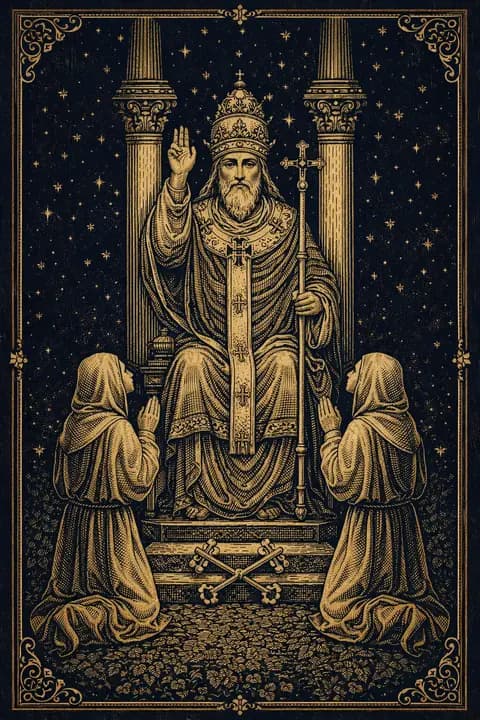
A hierophant was the priest who revealed sacred mysteries in ancient Greece, and the card shows a religious teacher on a throne between two pillars, blessing two followers who kneel before him. Older decks called him The Pope. Today readers rarely take him literally. He stands for any system of shared knowledge that you can join: a religion, a school, a profession, a family tradition, a recovery program, a martial art with a lineage.
Upright, the card says there is a known path and it is worth following for now. Learn the rules before you break them. Find a teacher. Take the course with the certificate. It also favors public commitments, the kind that are witnessed: weddings, ordinations, graduations, signing up. Where The High Priestess knows things privately, The Hierophant teaches them openly.
| Area | Upright | Reversed |
|---|---|---|
| Keywords | Tradition, belief, guidance, institutions | Rebellion, unconventional paths, challenging convention, personal beliefs |
| Love | Commitment, marriage, shared values | An unconventional relationship, or pressure to conform |
| Work | Training, a mentor, an established employer | Leaving a rigid system, doing it your own way |
| Yes or no | Yes | Maybe |
Symbols on The Hierophant card
The followers' robes carry roses and lilies, the same flowers as The Magician's garden: desire and purity, now disciplined by a tradition.
- The crossed keys at his feet: access to knowledge, and the keys of heaven and earth.
- The two kneeling followers: students, and the act of passing knowledge on.
- His raised hand in blessing, two fingers up: the link between the divine and the everyday.
- The triple crown and the triple cross: authority over body, mind and spirit.
- The two gray pillars: structure and law, plainer than The High Priestess's black and white.
Which rules are really yours?
Five cards for the commitment or choice in front of you: what supports it, what is in the way and what to do, read with your birth chart. Written by AI the moment you join.
Read my choiceThe Hierophant upright
Upright, The Hierophant is about belonging to something larger than yourself and learning from people who went before. It shows up when a structured path is the right one: an apprenticeship, a degree, joining a team with its own culture, or returning to the faith or customs of your family. It can also describe a mentor, therapist, priest or teacher who has something real to give you. The card asks you to be a student for a while, with humility.
Where The Hierophant shows up in life
Because the card is about institutions, its meaning depends on which one is in the picture. Readers look at the question and the surrounding cards to tell them apart.
- Education: exams, certification, a formal course, a teacher who matters.
- Religion and spirituality: a community, a ritual, a return to practice.
- Family: traditions, expectations, what your parents believed and expected of you.
- Work: a big company, a professional body, a set of rules you must learn.
- Love: marriage and the conventions that come with it.
The Hierophant reversed
Reversed, The Hierophant says the old rules do not fit. It can mean leaving a church, a career path or a family expectation that you followed because you were supposed to. It can mean questioning a teacher or an expert, or finding your own spiritual practice outside any institution. That is often healthy: the reversed card is the student who has learned enough to think for themselves.
It also has a darker side. Institutions can be rigid, dogmatic or abusive, and the reversed Hierophant sometimes names a group or a person whose authority is being used to control you. Trust your discomfort if a rule only seems to protect the people at the top.
The Hierophant tarot love meaning
In love, The Hierophant is the card of commitment made in public: moving in, meeting the family, engagement and marriage. It values shared beliefs over passing chemistry.
| Stage | Upright | Reversed |
|---|---|---|
| Single | Meeting someone through a community, a class or friends; someone with traditional values | Rejecting the usual script; dating differently, or feeling pressure to settle |
| Dating | Clear intentions and a relationship moving toward commitment | Different values about where it is going |
| In a relationship | Marriage, shared rituals, family blessing | A relationship outside convention, or one kept going only by expectation |
| With an ex | Counseling, mediation, or rules agreed for co-parenting | Breaking from the version of the relationship others expected |
The Hierophant as feelings
As feelings, The Hierophant means the person sees you as someone to be serious about. They respect you, may want to introduce you to their family, and think in terms of commitment. Their feelings may be expressed formally rather than passionately. Reversed, they may feel boxed in by expectations, theirs or yours, or want something less conventional than you do.
Career and money with The Hierophant
At work The Hierophant favors teaching, academia, religion, law, medicine, banking, government and any job with a long training path and a professional body. It is a good card for joining an established company or finding a mentor. With money it favors conventional choices: the pension, the savings account, a fee-only adviser. Reversed, it may be time to leave a rigid employer or try a less traditional route, such as going independent.
The Hierophant as advice
As advice, The Hierophant says ask someone who knows. Before you reinvent the wheel, find the person, the book or the course that has already solved your problem, and follow it properly for a while. Reversed, the advice flips: you have learned the rules well enough to know which ones you can break.
The Hierophant yes or no
The Hierophant is a yes, especially for questions about commitment, marriage, study, joining a group or following an established path. Reversed, it becomes a maybe: yes, if you are willing to do it your own way, or once you are sure the rules you are following are actually yours.
The Hierophant in past, present and future
Reversed in the past position, it often marks the moment you stopped believing what you were taught.
- Past: a tradition, an upbringing or a teacher shaped the beliefs you are now acting on.
- Present: you are being asked to learn, commit or join something with rules.
- Future: a mentor, a course, a ceremony or a formal commitment is coming.
The Hierophant's astrology, element and number
The Golden Dawn gave The Hierophant the sign of Taurus and the Hebrew letter Vav, a nail, the thing that joins one piece to another. Taurus is fixed earth: slow, loyal, rooted and resistant to change, which suits a card about lasting traditions. Waite's design echoes it, with the card's steady, symmetrical stillness.
Its number, 5, is the first number after the stable square of 4, and in the minor arcana fives are disruption. The Hierophant shows the other face of that number: the teaching that comes after a challenge, and the rules a community builds to handle conflict.
The Hierophant with other cards
Earth cards around it make the structure practical; Swords make it intellectual.
- The Hierophant and The Lovers: marriage, a commitment that is blessed and witnessed.
- The Hierophant and the Three of Pentacles: apprenticeship, learning a craft from a master.
- The Hierophant and The Emperor: institutions, law and established power.
- The Hierophant reversed and The Fool: leaving a tradition behind to find your own way.
- The Hierophant and the Ten of Cups: family traditions, a wedding, a home built on shared values.
The Hierophant in the Destiny Matrix
In the Destiny Matrix, a chart built from your birth date, The Hierophant is arcana 5. The energy of the teacher: passing on what is true and worth keeping. Lived in the plus, you explain, mentor and hold values people come back to. In the minus: preaching, judging, following rules you never chose.
Where The Hierophant sits in a matrix decides what it rules there: your calling card, your center, your talents, your karmic tail or your love and money line. The free destiny matrix calculator shows whether it is in yours, and where.
Which rules are really yours?
Five cards for the commitment or choice in front of you: what supports it, what is in the way and what to do, read with your birth chart. Written by AI the moment you join.
Read my choiceQuestions people ask
Read next
More in tarot